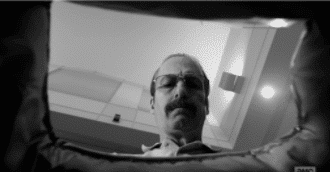
No matter the medium, the most important rule of storytelling is, “show don’t tell.” Writers want to captivate their audience through action, senses, and feelings, not hit them over the head with meaning. For this reason, visual storytelling is so important. An image can and should convey just as much power and meaning as a monologue, and often the end result is much more satisfying. Visual storytelling is the lifeline for crafting a powerful message.
Perhaps the best example today of strong visual storytelling is the AMC television crime drama Better Call Saul, the sister show to the astoundingly cinematic (and subjectively the turning point for “good television”), Breaking Bad, renowned for its gritty drama highlighted by creative and unique cinematography. Although the show reached its end in 2013, its style has continued to live on through the intensely intriguing Better Call Saul, which follows the story of the morally ambiguous lawyer Jimmy McGill before his appearance on Breaking Bad as Saul Goodman.
Character-based stories can be very difficult to shoot, especially in a medium like television that is so inherently dialogue-centric. Yet, showrunner Vince Gilligan has perfected the art of visual storytelling, through the use of the camera in shaping the atmosphere. Gilligan consistently incorporates foreground in almost every shot, with a mix of huge, dramatic wides as well as extreme close-ups, POV shots, and bird’s-eye shots that help set the scene and mood. Moreover, Gilligan constantly takes extremely creative approaches such as shooting from within objects and using time-lapses, which further engross the audience in the actions of the plot. These camera techniques give viewers details and clues about the story without using words, and create an effective and powerful engagement.
For instance, the subplot around Mike Ehrmantraut, a disgraced police officer investigating the Albuquerque drug scene, has some of the most memorable visual moments in Better Call Saul. In the season three premiere, Mike is frantically searching to see if his car has been bugged and the audience gets a glimpse of a lengthy montage in which he is deconstructing the whole car and laying it out piece by piece as the sun sets in the horizon. Through the use of highly stylized angular shots, we see how determined he is to find this bug, and we also see how long he spends doing this, with minimal indication from the storytellers. In the following scene, when Mike figures out where the bug is, the realization comes with a close-up of the character and of what he’s looking at: gas pump caps. This imagery is so much more powerful because the audience experiences it with the character.
Effective storytellers are able to trust their audience to properly interpret the visuals they create. The creativity and skill involved in connecting with an audience applies across formats, as this is true even in nonfiction commercial work. At ASL Productions, we produce powerful, quality content that engages its audience and solicits the desired response using creative styles such as the ones used in Better Call Saul. We never want to oversell to an audience; we want them to come to their own epiphanies through a personal interpretation of our visuals. A picture truly is worth a thousand words.
Why Podcasters and Producers From All Over the World Film at ASL Studios in NYC
We built ASL Studios for creators who don’t want to think about production. Show up, sit down, make something great. That pitch works really well for New York based teams. But something interesting happened along the way. More and more of our clients started flying in. A Podcast Studio NYC can be proud of. From […]
Why Midtown Manhattan Is Still the Most Practical Place to Shoot in NYC
New York City has no shortage of production neighborhoods. Studios are popping up all over Brooklyn, Downtown, Long Island City and everywhere else as content needs just keep growing. And yet, when it comes to actually getting a shoot done cleanly, efficiently, and without unnecessary friction, Midtown Manhattan continues to be the most practical place […]
Why Podcasts Should Be the Core of Your B2B Content Strategy
B2B marketing is hitting a wall. Email is saturated. Social media is full of busy, quick hit content. Webinars are hard to commit to in our busy schedules. Decision-makers are drowning in surface-level content while simultaneously tuning most of it out. But there’s one channel where their attention is not only intact, it’s growing. B2B […]